LVP vs Laminate Flooring: Which Should You Buy?
LVP vs laminate compared on water resistance, scratches, comfort, installation rules and 2026 prices from manufacturer guides, room by room.
By the GableMath team · Published · 4 min read
Choose luxury vinyl plank anywhere water is likely — kitchens, bathrooms, laundry rooms, basements — and in homes with pets. Choose laminate for living rooms, bedrooms and hallways when you want a harder, more scratch-resistant surface with a convincing wood look for a little less money.
- Bathroom, laundry, basement on a slab
- LVP (rigid core)
- Living room, bedrooms, hallway
- Laminate
- Big dogs, kids, spills
- LVP with a thick wear layer
- Lowest price per sq ft
- Laminate, by a few cents
Short answer: buy vinyl where water is a real risk, laminate where scratches are the bigger risk. Both are floating, click-together planks that mimic wood, and at 2026 prices they cost within about 30 cents a square foot of each other. What separates them is the core: luxury vinyl plank (LVP) is plastic all the way through, while laminate is a high-density wood-fiber board under a photographic layer and a very hard melamine wear surface. That one difference decides most of the rest.
LVP vs laminate at a glance
| Luxury vinyl plank (rigid core) | Laminate | |
|---|---|---|
| Core | Vinyl, often stone-plastic composite | High-density wood fiber |
| Water | Core doesn't swell | "Waterproof" lines resist surface spills; core is still wood fiber |
| Scratches | Depends on wear layer (12–22 mil is common) | Melamine surface is very scratch resistant |
| Dents | Can dent under narrow heavy loads | Harder surface, but chips at edges |
| Feel and sound | Softer and quieter underfoot | Firmer; can sound hollow without good underlayment |
| Acclimation (example brands) | LifeProof: none if stored properly | Pergo: 48 hours |
| Expansion gap | 1/4 in (LifeProof, COREtec) | 3/8 in (Pergo Pro) |
| Typical 2026 price (big box) | ~$2.98/sq ft (LifeProof) | ~$2.69/sq ft (Pergo Outlast+) |
Prices are the typical per-square-foot figures we track for our flooring calculator; they move with sales and vary by line.
Laminate vs vinyl plank: water and moisture
This is where the choice is easiest. A vinyl plank's core is plastic, so a spilled dog bowl, a dripping dishwasher or a wet bathroom floor won't make it swell. Rigid-core products such as LifeProof and COREtec are designed for kitchens, bathrooms and basements.
Laminate has come a long way. Lines like Pergo Outlast+ are sold as waterproof laminate, with sealed surfaces and edges built to hold off spills long enough to wipe them up. But the board under the picture is still compressed wood fiber. Our advice: if a room has a toilet, a tub, a washing machine or a sump pump, use vinyl, and read any laminate warranty for exactly what "waterproof" covers before you put it near water.
Basements need a moisture check either way. Installation guides set limits on slab moisture: LifeProof allows up to 85% relative humidity in the concrete, Pergo laminate up to 80%. A cheap moisture meter or a taped-down plastic sheet test will tell you whether you're close.
LVP vs laminate flooring: scratches, dents and feel
Laminate's top layer is melamine resin, and it's very hard. Claws, grit and sliding chairs that leave marks on many vinyl floors barely touch a good laminate. If you have a busy entry, big dogs or rolling office chairs and no water risk, that's a strong argument for laminate.
Vinyl's protection is its wear layer, a clear coating measured in mils. Lines from the same brand range from about 12 mil to 22 mil; for pets and kids, buy the thicker one. Vinyl is softer, which makes it quieter and a little warmer underfoot, but heavy, narrow loads — a refrigerator's feet, a piano, a desk chair without a mat — can dent it. Laminate doesn't dent as easily, but a dropped pan can chip a plank edge.
On looks, both use printed images. Many people find good laminate's embossed texture more convincing as wood; good vinyl has narrowed that gap.

Installation: the rules are different
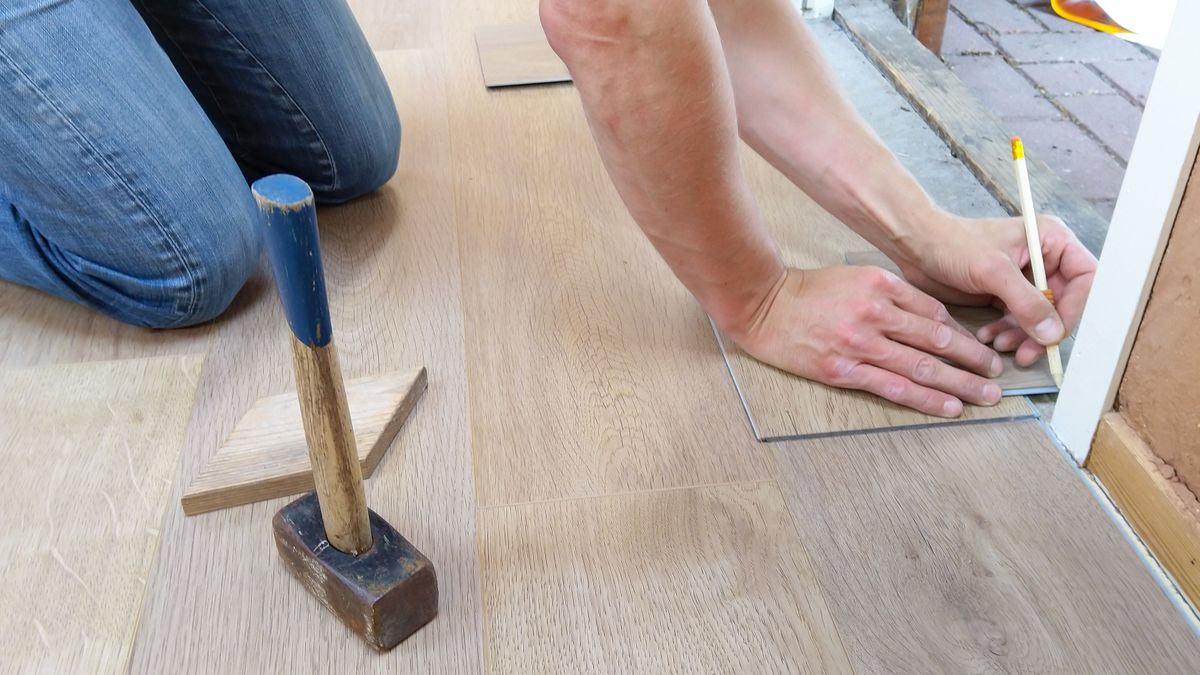
Both float over the subfloor and click together, so a careful DIYer can install either. The manufacturers' rules differ in ways that matter on the day:
- Acclimation. LifeProof says no acclimation is needed if the boxes were stored properly; Pergo laminate asks for 48 hours in the room.
- Expansion gap. Leave 1/4 in at walls for LifeProof and COREtec vinyl; Pergo Pro laminate wants 3/8 in. Baseboard or quarter-round must cover it — the baseboard calculator counts the pieces.
- Long runs and doorways. LifeProof allows runs up to 100 ft before a transition; Pergo calls for T-molding in rooms longer than 50 ft and in doorways narrower than 32 in.
- Flatness. LifeProof tolerates 1/4 in over 10 ft; COREtec and Pergo want 3/16 in over 10 ft. Fill low spots before you start — the self-leveling concrete calculator sizes the pour.
- Underlayment. Many planks have pad attached. LifeProof approves only its own underlayment, and Pergo only its own pads, so adding a random foam layer can void the warranty.
- Stairs. LifeProof's instructions say installing its planks on stairs voids the warranty; use the matching stair treads.
Cost: a real example
For a 500 sq ft open living area with 10% waste — 550 sq ft of flooring:
| Price per sq ft | Material cost | |
|---|---|---|
| Laminate (Pergo Outlast+) | $2.69 | about $1,480 |
| LVP (LifeProof) | $2.98 | about $1,640 |
The gap is about $160 on the flooring itself. Underlayment, transitions and baseboard are similar for both, and installation labor is usually similar too because both click together. Over the life of a floor, a difference that small shouldn't decide anything — the room should.
Our recommendation, room by room
- Kitchen, bathroom, laundry, mudroom, basement: LVP with a rigid core.
- Living room, bedrooms, hallways, home office: laminate, unless you want the softer, quieter feel of vinyl.
- Whole-house, one floor everywhere: LVP, so the kitchen and bath don't force a transition strip.
- Big dogs: LVP with a 20+ mil wear layer in wet areas; laminate in dry ones.
Whichever you choose, buy every box from the same production lot and keep one spare box for repairs. Measure each room with the square footage calculator, then let the flooring calculator turn the total into boxes with the right waste factor for your layout.
Questions people ask
What is the downside of LVP flooring?
It can dent under heavy, narrow loads such as appliance feet and furniture legs, it can fade or move in strong direct sun, and it's harder to repair than tile. Many brands also void the warranty if you use an unapproved underlayment — LifeProof, for example, approves only its own.
What lasts longer, vinyl or laminate flooring?
In dry rooms, both last for many years; laminate's melamine wear layer resists scratches better, while vinyl shrugs off water. In wet rooms vinyl lasts longer because its core doesn't swell. Compare the wear layer (in mils for vinyl) and the warranty terms for your room type.
Is laminate waterproof?
Some laminate lines, such as Pergo Outlast+, are sold as waterproof and are built to resist surface spills. The core is still a wood-fiber board, though, so check the warranty for how long water can sit and whether flooding from leaks is covered.
Is LVP or laminate cheaper?
Close. At 2026 big-box prices we track, Pergo Outlast+ laminate runs about $2.69 per sq ft and LifeProof vinyl about $2.98. Over a 500 sq ft job with 10% waste, that's roughly $1,480 versus $1,640 for materials.
Can you put LVP or laminate in a basement?
LVP is usually the better basement floor because it tolerates humidity and occasional water. Check your slab's moisture first: LifeProof allows up to 85% relative humidity in the concrete, Pergo laminate up to 80%.
Where these numbers come from
- LifeProof luxury vinyl flooring installation instructions (Home Depot) — No acclimation needed when stored properly; 1/4 in expansion gap; 100 ft run limit; 85% RH slab limit; approved underlayment only; stairs void warranty · checked October 2026
- Pergo laminate installation instructions — 48-hour acclimation; T-molding for rooms over 50 ft or doorways under 32 in; ≤80% RH slab; 3/16 in per 10 ft flatness · checked October 2026
- Pergo Pro laminate installation guide (Lowe's) — 3/8 in expansion gap; 12 in end-joint offset · checked October 2026
- COREtec / Shaw residential installation guidelines — Rigid-core vinyl: 3/16 in per 10 ft flatness; 1/4 in gap for rooms under 2,500 sq ft · checked October 2026